As part of my Master of Sustainable Energy, I completed a course in Net Zero Pathways for Business. This course explains the physical science of climate change, with discussion of climate models, projections and impact scenarios. Australian and international climate policies are presented and their implications for transitioning to a low carbon society will be explored.
One of the assignments has been to provide policy advice to the Minister for Climate Change and Energy, The Hon Chris Bowen MP , for creating jobs and growth opportunities as part of the government’s climate change and energy strategy.
To construct the policy advice, I first researched the minister’s ambitions for the nation to be a hydrogen superpower and AEMO’s estimates of the amount of electricity required to power a nascent hydrogen industry by 2050. By combining the data on the gap in generation and storage with the levelised cost of each technology from CSIRO’s Gencost report, I was able to estimate the cost required to become a hydrogen superpower.
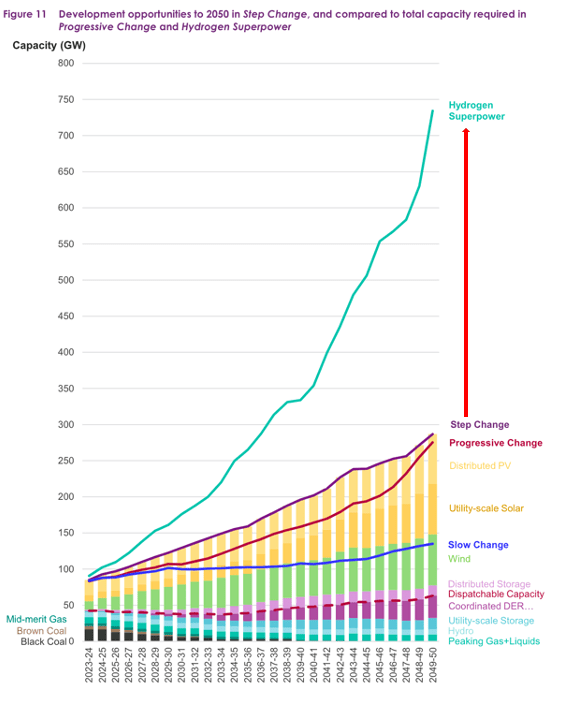
Although the cost could be considered eye-watering, usage of existing financial structures through organisations such as the CEFC are able to reduce the cost to the Australian taxpayer. In addition to partially funding the generation and storage, the creation of jobs, education and development of supporting industries ensures a holistic policy.
In conclusion, to ensure that Australia becomes a renewable energy superpower able to participate in the forecasted $1 trillion per year hydrogen industry by 2050, the Government should fund the CEFC with $276 billion over the next 27 years to co-invest in renewable energy generation capacity. At the same time, the Government should progressively increase the requirement for the renewable energy supply chain to be based in Australia whilst also stimulating demand for green hydrogen through green building standards, green exports, and better fuel efficiency standards. Appropriate workforce planning will be required as well as high levels of consultation with landowners and local communities to secure social license for new projects. Investment returns and savings from reduced capital costs should be reinvested into other existing Government programs. Together, these actions will turbocharge Australia’s jobs and economy whilst adapting to climate change and reducing our carbon footprint.
Click here to download a copy of my proposed energy policy along with the accompanying presentation.